Headcount is your biggest line item. Most teams guess at it.
I am Katelyn Laskosky. I do workforce planning and operations for professional services firms and startups in New York: how many people you need, in which roles, by when, and the system that makes them productive in weeks instead of quarters.

I have run the operation, not just advised on it.
Before consulting I owned workforce planning inside a high-volume business where a staffing decision showed up in the numbers the same day.
At McMaster-Carr I built the workforce planning models behind 136 people in customer service operations and 55 or more in warehouse strategy. That meant matching staffing to inbound volume, defining the KPIs that decided who did what, and building the reporting leadership actually used to make calls.
The results were operational rather than theoretical: productivity up 147 percent, 750,000 dollars in cost savings, onboarding time down 75 percent, inbound damages down 45 percent. I bring the same discipline to smaller New York teams, where the same problems appear earlier and cost proportionally more.
I hold a Master of Science in Business Analytics from Cornell and a degree in Economics from Bucknell. The analytics matter because a staffing model is only as good as the demand data underneath it.
Staffing built from demand
Headcount that follows actual volume and capacity, not last quarter's plan plus a guess.
Ramp measured in weeks
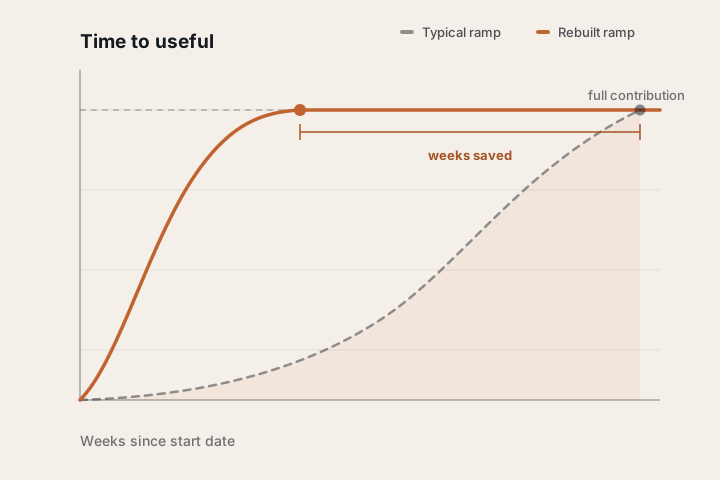
Onboarding and training designed around time-to-useful, so a new hire contributes before the quarter ends.
Reporting leadership opens
A short set of numbers that makes the next staffing decision obvious without a meeting.
Process that survives growth
Standards and handoffs written down, so performance stops depending on who happens to be in the room.
How the work runs
Own the outcome. Compress the timeline.
High agency means nobody waits to be told what the problem is. High acceleration means the fix ships this month, not next quarter. Every engagement runs against both.
Most operations consulting produces a deck. This produces a staffing model you can run payroll against, a ramp plan a manager can execute on Monday, and a report that tells you what to do next.
The work starts at the constraint that is costing you money right now, usually capacity, ramp time, or a handoff nobody owns, and fixes that before touching anything else.
Map the demand
Establish what actually drives workload: volume, seasonality, client mix, and how much of it each role really absorbs.
Model the capacity
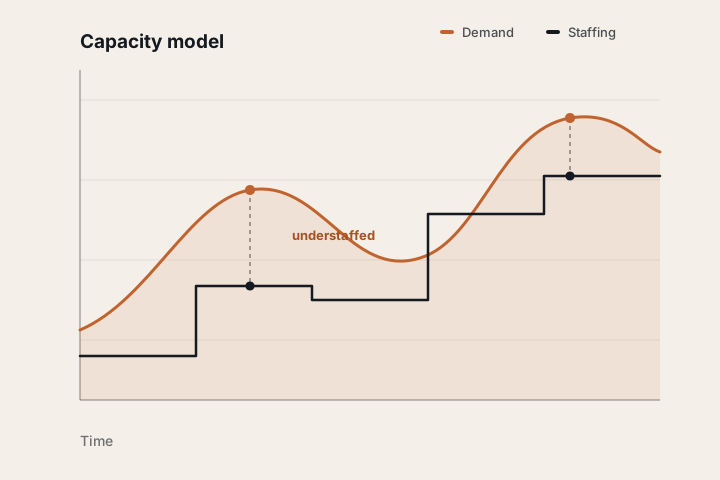
Build the staffing model that matches people to that demand and show where you are over, under, or simply misallocated.
Find the binding constraint
Identify the one thing capping throughput today: ramp time, a missing role, an unowned handoff, or a standard nobody follows.
Ship the fix
Rebuild that one thing, whether it is the ramp, the routing, or the standard. One constraint at a time, in weeks.
Instrument it
Leave behind the small set of numbers that makes the next staffing decision obvious without me in the room.
Where I work
Workforce planning
Know how many people you need, in which roles, by when, and what it costs before you commit.
- Capacity model tied to real demand
- Role-by-role staffing plan
- Hiring sequence with trigger points
Ramp and onboarding systems
Shorten the distance between a signed offer and a person who is actually contributing.
- Onboarding rebuilt around time-to-useful
- Training standards a manager can run
- Week-by-week performance expectations
Operating cadence and reporting
A short set of numbers that decides the next move, and a rhythm that keeps decisions from drifting.
- KPIs tied to throughput, not activity
- Reporting leadership actually opens
- Handoffs with a named owner
Search and placement
Once the plan says which role, I can help you fill it. The plan comes first, and sometimes the plan says do not hire.
- Roles defined by the capacity model
- Candidates briefed on the real job
- Every candidate gets a real answer
Start here
One session on your biggest staffing decision.
Sixty minutes, one constraint named, no slide deck. Bring the team you have, the growth you are planning, and the role you are unsure about. You leave with a view on whether that hire is the constraint, and what to do first if it is not.
Working session
Tell me what you are about to hire for.
Include your team size today, the growth you are planning for the next two quarters, and the role you are unsure about. That is enough for a useful first reply.
Based in New York, working with professional services firms and startups. Email or LinkedIn both reach me. First reply within two business days.
Evidence
The numbers came from running it, not recommending it.
Every figure below was delivered inside an operating role with real payroll, real volume, and same-day consequences. None of it came from a slide.
Consulting that has never carried an operating number tends to optimise the wrong thing. The plans below were built, staffed, and then lived with.
That is the whole argument for hiring an operator instead of an adviser at this stage: the model has to survive contact with a real schedule.
Productivity up 147 percent
Customer service operations at McMaster-Carr, generating 750,000 dollars in cost savings.
Onboarding time down 75 percent
Scalable training and ramp systems built so new hires reached full contribution far sooner.
Productivity up 132 percent
Warehouse strategy and operations, with workforce planning owned for 55 or more employees.
Inbound damages down 45 percent
Root cause analysis and carrier performance strategy across FedEx, XPO, TForce, and regional partners.
%
Productivity gain
K
Cost savings, USD
People planned
%
Faster onboarding
Before you reach out
Are you a consultant or a recruiter?
Both, in that order. The planning work decides which roles you actually need. Search only makes sense after that, and I will tell you when a hire is not the answer.
How big does a team need to be for this to be worth it?
Roughly ten to two hundred people. Below that, capacity planning is a spreadsheet you can run yourself. Above that, you need someone in-house full time, and I would rather help you hire them.
What do I actually get at the end?
A staffing model you can run payroll against, a ramp plan a manager can execute, and a short reporting set. Not a strategy deck.
What does High Agency, High Acceleration mean?
It is the standard the work is held to. High agency: nobody waits to be told what the problem is. High acceleration: the fix ships in weeks. If an engagement is not meeting both, something is wrong with it.
Do you work outside New York?
The practice is built around New York professional services firms and startups, where I can be in the room. Remote engagements are possible, but the in-person work is better and I will say so.
What should the first message include?
Team size today, the roles you have, the growth you are planning for the next two quarters, and the hire you are unsure about. That is enough for a specific first reply.
What you get back
A direct reply naming the constraint I would look at first, and whether the hire you are considering is actually it.
Get in touch